
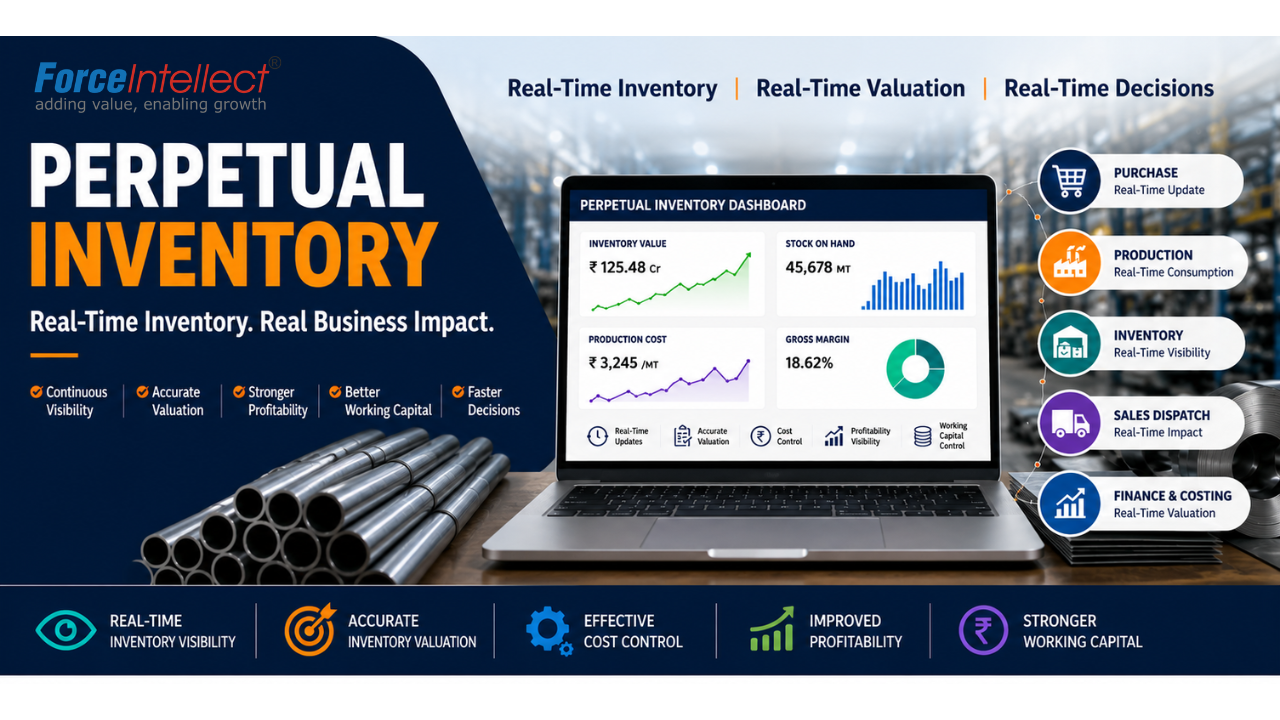
What Is Perpetual Inventory? Complete Guide for Manufacturing Companies
Introduction
Perpetual Inventory is a real-time inventory accounting system that continuously updates inventory quantities, inventory valuation, production costs, profitability, and financial records whenever a transaction occurs.
Many manufacturing companies know what inventory they have. However, without Perpetual Inventory Accounting, they often struggle with delayed financial visibility, inventory inaccuracies, hidden profitability leakages, and excess working capital locked in stock, making it difficult to take timely corrective actions.
As manufacturing companies face increasing competition, rising costs, and shrinking margins, adopting Perpetual Inventory is essential to improve inventory accuracy, reduce working capital, strengthen cost control, and enable faster, data-driven decision-making.
What Is Perpetual Inventory?
Perpetual Inventory is an inventory accounting method in which every inventory transaction automatically updates:
- Inventory Quantity
- Inventory Value
- Production Cost
- Work-in-Progress (WIP)
- Cost of Goods Sold (COGS)
- Financial Accounting Records
- Profitability
- Working Capital Position
A perpetual inventory system ensures that inventory records and financial records remain synchronized at all times. This provides the real-time visibility needed to manage costs, inventory, and profitability effectively.
Why Is Perpetual Inventory Important for Manufacturing Companies?
Manufacturing companies operate in environments with:
- Continuous material movement
- Multiple warehouses
- Production consumption
- Inventory transfers
- Freight expenses
- Overhead allocations
- High working capital requirements
Every inventory transaction impacts profitability. Yet many organizations still rely on inventory systems that update stock quantities but delay financial updates until month-end. This creates:
- Delayed profitability visibility
- Inventory valuation mismatches
- Weak working capital control
- Manual reconciliation efforts
- Slower business decisions
Perpetual inventory accounting eliminates these problems by providing continuous financial visibility.
How Does a Perpetual Inventory System Work?
A perpetual inventory system updates inventory and accounting records immediately after every transaction.
1. Material Purchase
When raw material is purchased:
- Inventory quantity increases
- Inventory value increases
- Freight allocations update
- Accounting entries are generated automatically
2. Material Issue to Production
When material is consumed:
- Inventory quantity decreases
- Production cost updates instantly
- Work-in-progress valuation updates
- Actual consumption becomes visible
3. Production Completion
When finished goods are produced:
- WIP value transfers automatically
- Finished goods inventory updates
- Product costing becomes available
4. Sales Dispatch
When finished goods are dispatched:
- Inventory reduces
- Cost of Goods Sold updates
- Profitability impact becomes visible immediately
5. Inventory Adjustment
When shortages, excess consumption, or stock losses occur:
- Variances become visible immediately
- Corrective actions can be taken faster
This continuous synchronization is what makes perpetual inventory accounting superior to traditional inventory tracking methods.
Example of Perpetual Inventory Accounting / Real Time Accounting during Material Purchase & Receipt
Suppose your company purchases:
| Item | Value |
|---|---|
| Material | HR Coil |
| Quantity | 100 MT |
| Rate | ₹60,000 / MT |
| Material Value | ₹60,00,000 |
| Freight | ₹2,00,000 |
| Total Inventory Value | ₹62,00,000 |
Step 1 : Purchase Department
- Purchase Order created.
- Business Impact: ✔ Supplier committed. ✔ Material expected.
- Accounting Entry : No accounting entry yet.
Step 2 : Stores Department
- Material received.
- GRN generated.
- Inventory immediately increases.
| Before | After |
|---|---|
| 250 MT | 350 MT |
Step 3 : Finance Department
Automatic Journal Entry
| Debit | Credit |
|---|---|
| Inventory A/c ₹62,00,000 | GR/IR A/c ₹62,00,000 |
| Input GST A/c | Supplier GST |
No manual journal required.
Step 4 : Costing Department
Immediately updated
✅ Average Cost
✅ Inventory Valuation
✅ Material Cost
Step 5 : Planning Department
MRP immediately knows Available Material 350 MT
Production can start.
Step 6 : CEO Dashboard
| KPI | Before | After |
|---|---|---|
| Inventory Value | ₹8.5 Cr | ₹9.12 Cr |
| Working Capital | ₹42 Cr | ₹42.62 Cr |
| Available Material | 250 MT | 350 MT |
Everything updates instantly. No month-end waiting.

Benefit of Perpetual Inventory
Every department works with the same real-time information, eliminating delays, duplicate entries, and manual reconciliation.
Perpetual Inventory vs Periodic Inventory
One of the most common questions manufacturing leaders ask is:
What is the difference between perpetual inventory and periodic inventory?
| Feature | Perpetual Inventory | Periodic Inventory |
| Inventory Updates | Real-Time | Period-End |
| Inventory Valuation | Continuous | Periodic |
| Production Cost Visibility | Immediate | Delayed |
| Profitability Tracking | Real-Time | Month-End |
| Working Capital Visibility | Continuous | Limited |
| Financial Accuracy | Higher | Moderate |
| Decision Making | Faster | Delayed |
| Audit Readiness | Strong | Moderate |
The larger the manufacturing operation, the greater the benefits of perpetual inventory accounting.
What Are the Benefits of Perpetual Inventory?
1. Real-Time Inventory Visibility
Manufacturing companies gain complete visibility into:
- Raw Material Inventory
- Work-in-Progress Inventory
- Finished Goods Inventory
- Inventory Across Multiple Locations
Decision-makers always have access to current inventory information.
2. Accurate Inventory Valuation
Inventory valuation is continuously updated.
Management can instantly view:
- Raw material value
- WIP value
- Finished goods value
- Inventory asset value
This improves financial reporting accuracy and strengthens balance sheet visibility.
3. Better Production Cost Control
Manufacturing profitability depends on controlling production costs.
Perpetual inventory accounting provides real-time visibility into:
- Material Consumption
- Production Cost
- Yield Losses
- Scrap Generation
- Process Variances
This allows organizations to detect cost overruns early.
4. Real-Time Profitability Visibility
Many companies discover profitability issues weeks after they occur.
With perpetual inventory:
- Cost updates instantly
- Profitability updates continuously
- Margins become visible faster
Management can take corrective actions before problems become significant.
5. Improved Working Capital Management
Inventory often represents 30% to 70% of a manufacturing company’s working capital.
Perpetual inventory helps organizations:
- Reduce excess inventory
- Improve inventory turnover
- Lower carrying costs
- Optimize cash flow
This directly improves working capital performance.
6. Faster Month-End Closing
Finance teams spend less time reconciling inventory records and accounting records.
Benefits include:
- Faster month-end closing
- Faster year-end closing
- Reduced manual effort
- Improved financial accuracy
7. Better Audit Readiness
Every transaction creates a complete audit trail.
Organizations gain:
- Stronger compliance
- Better traceability
- Easier audits
- Reduced adjustment entries
What Are the Risks of Not Using Perpetual Inventory?
Manufacturers without perpetual inventory often face:
- Inventory and Accounting Mismatches: Inventory records and financial books show different values.
- Delayed Cost Visibility: Production costs are calculated after transactions occur.
- Inventory Losses Detected Too Late: Shortages, leakages, and excess consumption remain hidden.
- Weak Working Capital Control: Management lacks real-time visibility into inventory investment.
- Delayed Profitability Reporting: Business leaders cannot accurately monitor margins.
- Slower Decision-Making: Important decisions rely on outdated information.
How Does Perpetual Inventory Improve Working Capital?
It improves working capital by:
- Reducing excess inventory
- Improving inventory turnover
- Identifying slow-moving stock
- Reducing inventory carrying costs
- Improving purchasing decisions
- Optimizing stock levels
Better inventory visibility directly improves cash flow.
How Does Perpetual Inventory Improve Profitability?
It impacts profitability through:
- Better Cost Visibility: Actual production costs become visible immediately.
- Reduced Inventory Losses: Inventory discrepancies are detected sooner.
- Better Material Control: Material consumption becomes more accurate.
- Faster Corrective Action: Management can respond before losses accumulate.
- Improved Pricing Decisions: Accurate costing supports better pricing strategies.
Which Industries Benefit Most from Perpetual Inventory?
Perpetual inventory accounting is especially valuable in industries with complex inventory movement and production processes. These include:
Steel Manufacturing
Steel plants require:
- Heat-wise costing
- Grade-wise costing
- Yield analysis
- Scrap tracking
- Production visibility
ERP Software for Steel with Perpetual inventory supports all these requirements.
Steel Pipes and Tubes
Manufacturers need:
- Coil tracking
- Production costing
- Batch traceability
- Real-time inventory valuation
Ferro Alloys
Inventory visibility is critical due to fluctuating raw material costs and energy expenses.
Chemicals & Specialty Chemicals
Chemical companies require:
- Batch-wise inventory tracking
- Lot traceability
- Cost visibility
- Compliance reporting
Chemical ERP Software with Perpetual inventory supports all these requirements.
Transmission Line Towers, Engineering and Fabrication
Transmission Line Tower companies benefit from:
- Project-wise material tracking
- Material reservation
- Consumption control
- Work-in-progress visibility
What Role Does ERP Software Play in Perpetual Inventory?
A perpetual inventory system requires deep integration between:
- Procurement
- Inventory
- Production
- Costing
- Finance
- Sales
Modern Manufacturing ERP Software like Spectrum ERP enables this integration. Without ERP integration, maintaining accurate perpetual inventory becomes difficult and heavily dependent on manual reconciliation. Advanced manufacturing ERP solutions automatically synchronize inventory and accounting transactions in real time.
Expert Insight
Many manufacturing companies believe they have inventory visibility because they know stock quantities. However, inventory quantity alone does not provide business visibility. True visibility requires understanding:
- Inventory Value
- Production Cost
- Profitability Impact
- Working Capital Impact
- Financial Performance
This is why perpetual inventory accounting has become a strategic capability rather than simply an accounting feature.
Summary
Perpetual Inventory is no longer just an inventory management technique. It is a real-time financial control system that helps manufacturing companies improve profitability, strengthen working capital management, reduce inventory losses, improve costing accuracy, and make faster decisions.
As manufacturing businesses become more competitive, organizations that operate with real-time inventory visibility and real-time financial visibility will have a significant advantage over those relying on delayed reporting and manual reconciliation.
The question is not whether perpetual inventory accounting is valuable. The question is whether your manufacturing company can afford to operate without it.
Want to Know How Much Perpetual Inventory Could Improve Your Business? Schedule a Discovery Call Now
Frequently Asked Questions About Perpetual Inventory
What is perpetual inventory in manufacturing?
Perpetual inventory is a real-time inventory accounting system that continuously updates inventory quantities, inventory valuation, production costs, and financial records whenever inventory transactions occur.
What is the difference between perpetual inventory and periodic inventory?
Perpetual inventory updates records continuously, while periodic inventory updates records only at predefined intervals such as month-end or year-end.
Why is perpetual inventory important?
It improves inventory accuracy, profitability visibility, working capital control, audit readiness, and decision-making speed.
What are the advantages of perpetual inventory accounting?
Key advantages include:
- Real-time inventory valuation
- Better production cost control
- Faster financial reporting
- Improved profitability visibility
- Better working capital management
Can ERP software support perpetual inventory accounting?
Yes. Manufacturing ERP systems like Spectrum ERP support perpetual inventory accounting by automatically synchronizing inventory, production, costing, and finance transactions.
